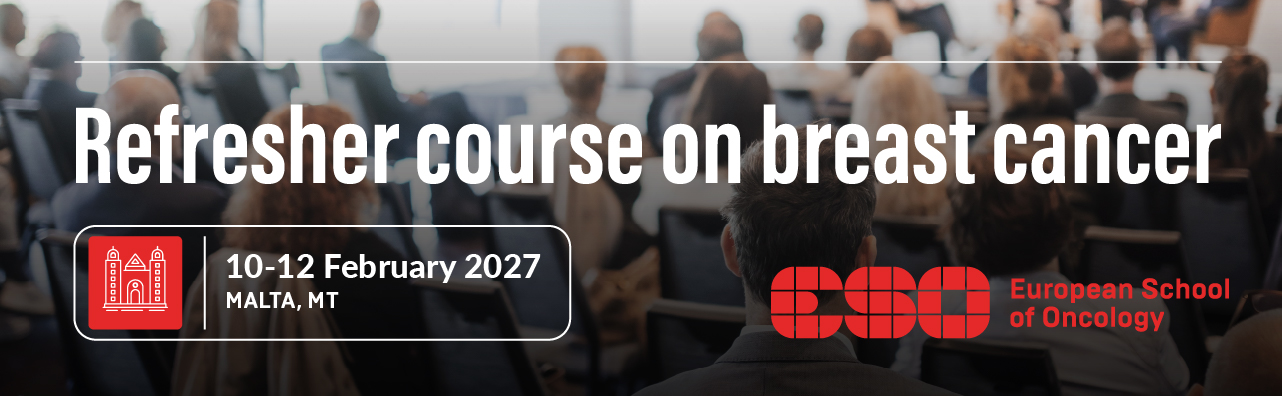
Refresher course on breast cancer
Refresher course on breast cancer
COURSE LEADERSHIP
Chairs - M.J. Cardoso, PT; D. Gabrys, PL; M. Lambertini, IT
College Representative - F. Kraja, AL
COURSE OVERVIEW
Breast cancer management is evolving rapidly, driven by advances in precision medicine, multidisciplinary care, molecular diagnostics, surgical and radiation de-escalation, novel systemic therapies, and digital health. This course aims to provide participants with an up-to-date overview of the evidence that is changing clinical practice and improving patient outcomes.
Designed for enhancing multidisciplinary decisions—including medical, surgical and radiation oncologists, radiologists, pathologists and other specialists involved in breast cancer care —the course will promote integrated decision-making throughout the patient journey, from diagnosis to survivorship.
Participants will review recent developments in breast imaging, pathology, molecular profiling and germline genetics, and discuss how these tools can be integrated to personalise treatment recommendations. Current standards and emerging evidence in surgery, radiotherapy and systemic therapy will be presented with particular emphasis on treatment optimisation through both escalation and de-escalation strategies.
The programme will also explore the growing role of digital health, artificial intelligence and patient-reported outcomes in supporting clinical decision-making, improving communication and enabling more personalised care. Particular attention will be given to shared decision-making, survivorship, quality of life and fertility preservation, recognising that optimal breast cancer care extends beyond disease control.
Learning will be centred around interactive multidisciplinary tumour boards based on clinical cases submitted by participants. Faculty-led discussions will integrate current international guidelines with recent evidence and ongoing controversies, allowing participants to understand not only what to do, but also why treatment recommendations continue to evolve.
Ultimately, the course aims to equip physicians with the knowledge and practical skills required to deliver evidence-based, personalised and patient-centred breast cancer care in an increasingly complex therapeutic landscape.
LEARNING OBJECTIVES
After completing this course, participants will be able to:
- Review recent advances in breast cancer epidemiology, biology and clinical management, and understand their impact on everyday practice.
- Integrate modern diagnostic approaches—including advanced breast imaging, pathology, molecular profiling, germline genetics and emerging biomarkers—to optimise diagnosis, staging and treatment selection.
- Understand current and emerging approaches to response assessment following neoadjuvant therapy and appreciate the evolving role of imaging, pathology and minimal residual disease assessment.
- Apply contemporary principles of local treatment, including breast surgery, axillary management and radiotherapy, with particular emphasis on evidence supporting treatment de-escalation.
- Select optimal systemic treatment strategies across early and metastatic breast cancer using tumour biology, biomarkers and patient characteristics to individualise care.
- Recognise the clinical implications of recent advances in HER2-positive, triple-negative and hormone receptor-positive breast cancer, including post-neoadjuvant treatment strategies and sequencing of therapies.
- Discuss challenging clinical scenarios including hereditary breast cancer, breast cancer during pregnancy, very young patients, fertility preservation and survivorship.
- Appreciate the growing role of digital health, artificial intelligence and patient-reported outcomes in supporting multidisciplinary care and shared decision-making.
- Strengthen multidisciplinary clinical decision-making through interactive tumour board discussions based on participant-submitted cases.
- Understand the organisation of high-quality breast cancer services, including Breast Units, quality indicators, certification processes and multidisciplinary collaboration.
COURSE LANGUAGE and SCHEDULE
The course will be held in English. No translation will be provided.
10th February 2027: Arrival day
11th February 2027: Full-day course
12th February 2027: Half-day course
REGISTRATION FEE
The top 30 applicants will receive a place with accommodation with a reservation fee of EUR 150.
A further 30 applicants will be selected if eligible with a reservation fee of EUR 75 without accommodation.
The fee includes:
- Access to the full course and its educational resources
- Two nights’ accommodation (arrival: Wednesday 10th February – departure: Friday 12th February 2027)
- Meals as outlined in the programme
Travel costs are not covered and must be arranged independently.
ESO College members at the time of application receive a 50% discount on the registration fee.
The fee is a non-refundable contribution towards organisational costs and will not be reimbursed in the case of withdrawal or non-attendance, regardless of the reason.
ACCREDITATION
A certificate of attendance will be issued upon completion of:
• 100% attendance at the in-person course
• Completion of the evaluation questionnaire
• Application for CME recognition will be submitted to the European Accreditation Council for Continuing Medical Education (EACCME).
ESO COLLEGE MEMBERSHIP
Participation in this course grants eligibility to join the ESO College and allows existing members to earn 18 ESO College credits toward their progression.
Visit ESO College dedicated section for more information on membership and benefits.
INSURANCE
Participants are advised to take out personal and travel insurance. ESO is not responsible for incidents during the event.
CONTACTS
Alice Ciocchini - aciocchini@eso.net
Elena Fiore - efiore@eso.net
10/02/2027 18:30
Participant registration at the hotel
10/02/2027 19:30
End of the registration
11/02/2027 10:30
Welcome
11/02/2027 10:45
Where are we in breast cancer research in 2027?
11/02/2027 11:15
The Right Diagnosis : identifying the best treatment pathway
11:15
Modern Breast Imaging: what has changed
11:45
Pathology, biomarkers and molecular profiling: what clinicians need to know
12:15
From Germline testing to treatment: personalized risk assessmeny and current and future therapeutic implications
11/02/2027 12:45
Lunch
11/02/2027 14:00
Chosing the best locorregional treatment: how much is enough?
14:00
Tailoring breast surgery in 2027
14:20
Axillary management after the de-escalation revolution
14:40
The future of Breast Radiotherapy: smarter de-escalation, including after neo-adjuvant therapy
11/02/2027 15:00
Coffee break
11/02/2027 15:30
Personalizing systemic treatment
15:30
State of the art on neoadjuvant therapy
16:00
Escalation and de-escalation strategies in adjuvant therapy
16:30
Tumour genomic testing for huiding treatment decisions: current and future use
11/02/2027 16:50
Beyond Cancer Treatment
16:50
Shared decision-making, survivorship and quality of life: late toxicities and rehabilitation
11/02/2027 17:10
Interactive Multidisciplinary Tumour Board
17:10
Tumor board: Selected clinical cases, presented by participants
11/02/2027 18:10
End of the day and free night
12/02/2027 08:30
Outside the box: managing challenging scenarios
08:30
Breast cancer in young women (including adjuvant endocrine therapy) and oncofertility issues
08:50
News in the local and systemic management of brain metastases
09:10
Oligometastatic breast cancer: integrating local and systemic therapies
09:30
Redefining the Resection: Advanced Surgical Management for Locoregional Recurrence
09:50
To Reirradiate or Not? The Evolving Role of Radiation in Local Recurrence
12/02/2027 10:10
Coffee break
12/02/2027 10:30
Managing advanced disease
10:30
Current treatment sequencing in HR-positive/HER2-negative disease
10:50
Current treatment sequencing in HER2-positive disease
11:10
Current treatment sequencing in triple-negative breast cancer
12/02/2027 11:30
Looking ahead
11:30
Artificial intelligence, digital health and future biomarkers
12:10
Breast Cancer Units of the Future: quality, multidisciplinary care and innovation
12/02/2027 12:30
Building Your Career in Breast Cancer: Opportunities, Research and International Collaboration
12/02/2027 13:10
Closing remarks
12/02/2027 13:20
End of the course
Applications deadline: 22nd November 2026
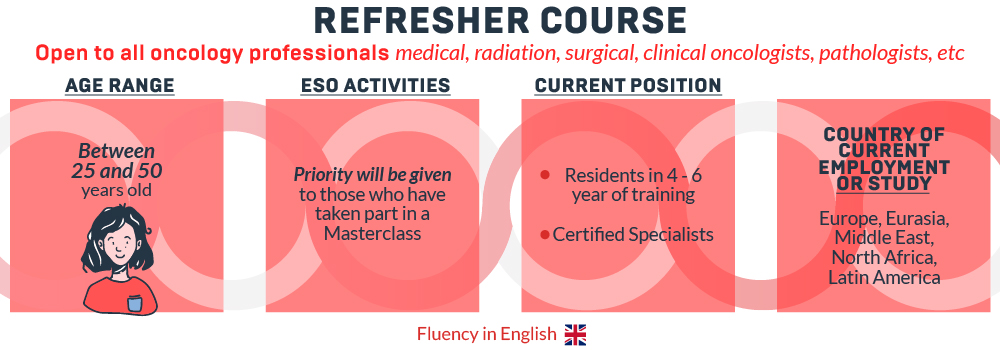
IDEAL CANDIDATE
How to Apply
If interested please apply online.
The application process involves completing an online questionnaire, where you will provide details about:
- Your work experience and training
- Your research experience and publications
- Your motivation and personal commitment to participating in this activity
During the application, you will also need to upload the following documents in PDF format:
- Recommendation letter: A letter from your head of department or mentor, written on official hospital letterhead and signed.
- Curriculum Vitae (CV)
- Clinical case: Please use the Clinical Case Template (download it HERE).
Applications without the required documents will not be considered. Please ensure all files are ready before starting the application form.
Abstract guidelines
Your abstract should present a challenging clinical case encountered in your daily practice that illustrates a relevant diagnostic or therapeutic dilemma.
A selected number of participants will be invited to present their case during an interactive multidisciplinary tumour board discussion with the faculty.
The abstract should include:
• Patient presentation and diagnostic work-up
• Treatment strategy and clinical outcome (where available)
• The rationale behind key management decisions
• A major clinical controversy or unanswered question illustrated by the case
• At least three discussion questions for the faculty and audience
• Three key learning points
Selection Process
Applications are evaluated through a two-step process:
- Automated Scoring: Some responses are assessed using a predefined scoring system to ensure fairness and consistency. Points are assigned based on your answers.
- Committee Evaluation: Other sections, including your qualitative responses, are reviewed and scored by our selection committee.
This type of evaluation ensures a transparent and unbiased selection of top candidates for participation in this activity.
Selected participants will be notified in December 2026.
Please ensure all documents are ready before starting the online application. Incomplete submissions will not be considered.
You will be asked to accept ESO’s Data Protection Statement during the application process.
