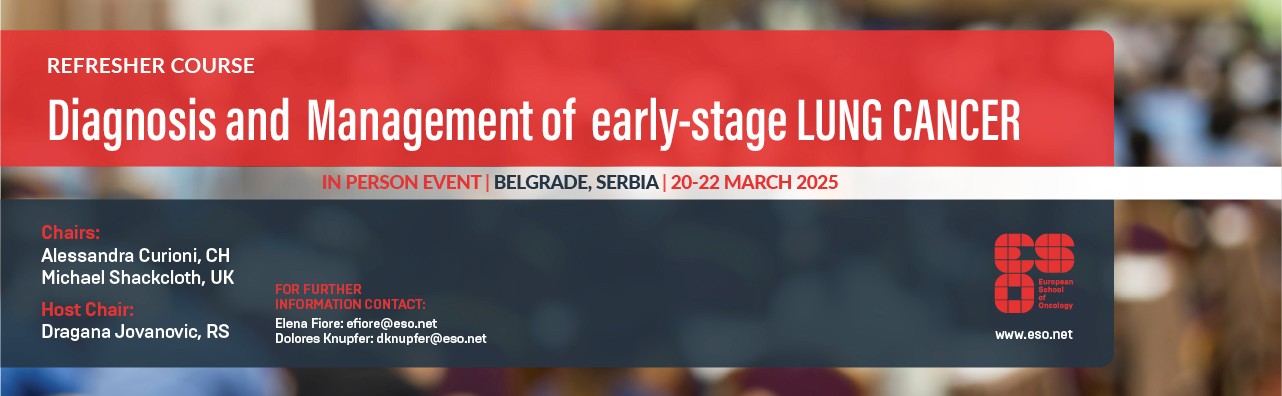
Refresher course for diagnosis and management of early-stage lung cancer
Refresher course for diagnosis and management of early-stage lung cancer
Course Leadership
Chairs: Alessandra Curioni, CH – Michael Shackcloth, UKHost chair: Dragana Jovanovic, RS
Course Overview
This course aims to provide a comprehensive overview of the latest diagnostic and therapeutic approaches in the management of early-stage lung cancer.It is designed to enhance multidisciplinary collaboration between respiratory physicians, thoracic surgeons, and oncologists to support accurate diagnosis, staging, and the development of personalised treatment plans.
Participants will explore recent advancements in imaging techniques, biopsy procedures, molecular testing, surgical strategies, and systemic therapies. The course equips attendees with the tools to deliver timely, targeted, and effective interventions for early-stage lung cancer.
In addition, the course will deepen participants' understanding of surgical and non-surgical treatment options, including minimally invasive surgery, stereotactic body radiotherapy (SBRT), and the role of adjuvant therapies. By integrating case-based learning and evidence-based guidelines, the course promotes a patient-centred approach, underlining the importance of shared decision-making and long-term follow-up.
Ultimately, this programme seeks to empower physicians to improve patient outcomes, reduce recurrence rates, and enhance survival and quality of life.
The course is intended for all physicians involved in the management of early-stage lung cancer, including medical and surgical oncologists, pathologists, pulmonologists, and radiologists.
Learning Objectives
Participants will:- Gain insight into the epidemiology and burden of lung cancer in Europe
- Refresh knowledge of lung cancer screening benefits and explore open questions around screening programmes
- Understand updates introduced in the TNM 9 staging system
- Learn best practices for diagnosing and staging lung cancer
- Explore the natural history and management of ground-glass opacities
- Review recent advances in peri-operative cancer treatment
- Examine the clinical challenges associated with increased use of immunotherapy
- Understand the indications and benefits of segmentectomy versus lobectomy for early-stage disease
- Evaluate the pros and cons of different treatment approaches across various stages of lung cancer
- Compare follow-up strategies after treatment and assess supporting evidence
Language
The course will be held in English.No translation will be provided.
Reservation Fee
Selected participants will be required to confirm their attendance by paying a registration fee of EUR 150,00.The fee includes:
- Access to the full course and its educational resources
- Two nights’ accommodation at the event venue (arrival: Thursday 20 March – departure: Saturday 22 March 2025)
- Meals as outlined in the programme
Travel costs are not covered and must be arranged independently.
ESO College members at the time of application receive a 50% discount on the registration fee.
The fee is a non-refundable contribution towards organisational costs and will not be reimbursed in the case of withdrawal or non-attendance, regardless of the reason.
CME Accreditation
This course has been accredited by the European Accreditation Council for Continuing Medical Education (EACCME)* to provide a maximum of 11 European CME credits (ECMEC®s) for medical specialists.Each medical specialist should claim only those credits that they actually spent in the educational activity.
Through an agreement between the European Union of Medical Specialists and the American Medical Association, physicians may convert EACCME® credits to an equivalent number of AMA PRA Category 1 Credits™.
Information on the process to convert EACCME® credits to AMA credits can be found here.
Live educational activities occurring outside of Canada, recognised by the UEMS-EACCME® for ECMEC® credits are deemed to be Accredited Group Learning Activities (Section 1) as defined by the Maintenance of Certification Program of the Royal College of Physicians and Surgeons of Canada.
*The EACCME is an institution of the European Union of Medical Specialists (UEMS), www.uems.net.
It has been accredited by the European Accreditation Council for Continuing Medical Education (EACCME®)
ESO College Membership
Participation in this course grants eligibility to join the ESO College and allows existing members to earn 9 ESO College credits toward their progression.Visit ESO College dedicated section for more information on membership and benefits.
Insurance
Participants are advised to take out personal and travel insurance. ESO is not responsible for incidents during the event.Contacts – Organising Secretariat
Alexandra Zampetti - azampetti@eso.netDolores Knupfer - dknupfer@eso.net
Registration at hotel
Registration for local participants
Welcome – HE Luca Gori, Italian Ambassador to Serbia, RS
Lung cancer in Europe
Screening for lung cancer
TNM 9
Coffee break
Pre-operative diagnostics: a radiologist’s perspective
Pre-operative diagnostics: a pulmologist’s perspective
Pathology and molecular markers
Management of ground glass opacities
Lunch
Standard radiotherapy
Stereotactic ablative radiotherapy for early stage lung cancer
Peri-operative systemic anti-cancer treatment
Challenges after immunotherapy
Coffee break
Segmentectomy for early stage lung cancer
Debate: Operable or not-operable that is the question?
Follow-up of patients following radical treatment of early stage lung cancer
Multidisciplinary case discussions
Coffee break
Multidisciplinary case discussions
Closing remarks

Alberto Costa
European School of Oncology, CEO, Milano, IT

Alessandra Curioni-Fontecedro
Freiburger Spital, HFR Kantonsspital Freiburg, Department of Oncology, Freiburg, CH

Dragana Jovanovic
Internal Medicine Clinic "Akta Medica", Dept. of Thoracic Oncology, Belgrade, RS

Ermina Iljazovic
University Clinical Center Tuzla, Dept. of Pathology, Tuzla, BA

Gordana Petkovska
University Clinic of Radiotherapy and Oncology, Radiotherapy And Oncology Dept., Skopje, MK

Jarushka Naidoo
Waterford Regional Hospital, Medical Oncology Dpt., Waterford, IE

Marko Kostic
University of Belgrade, Medical Faculty, Belgrade, RS

Michael Shackcloth
Liverpool Heart and Chest Hospital, Department of Thoracic Surgery, Liverpool, UK
Milorad Bijelovic
Institute for Pulmonary Diseases of Vojvodina,Thoracic Surgery Clinic, Sremska Kamenica, RS
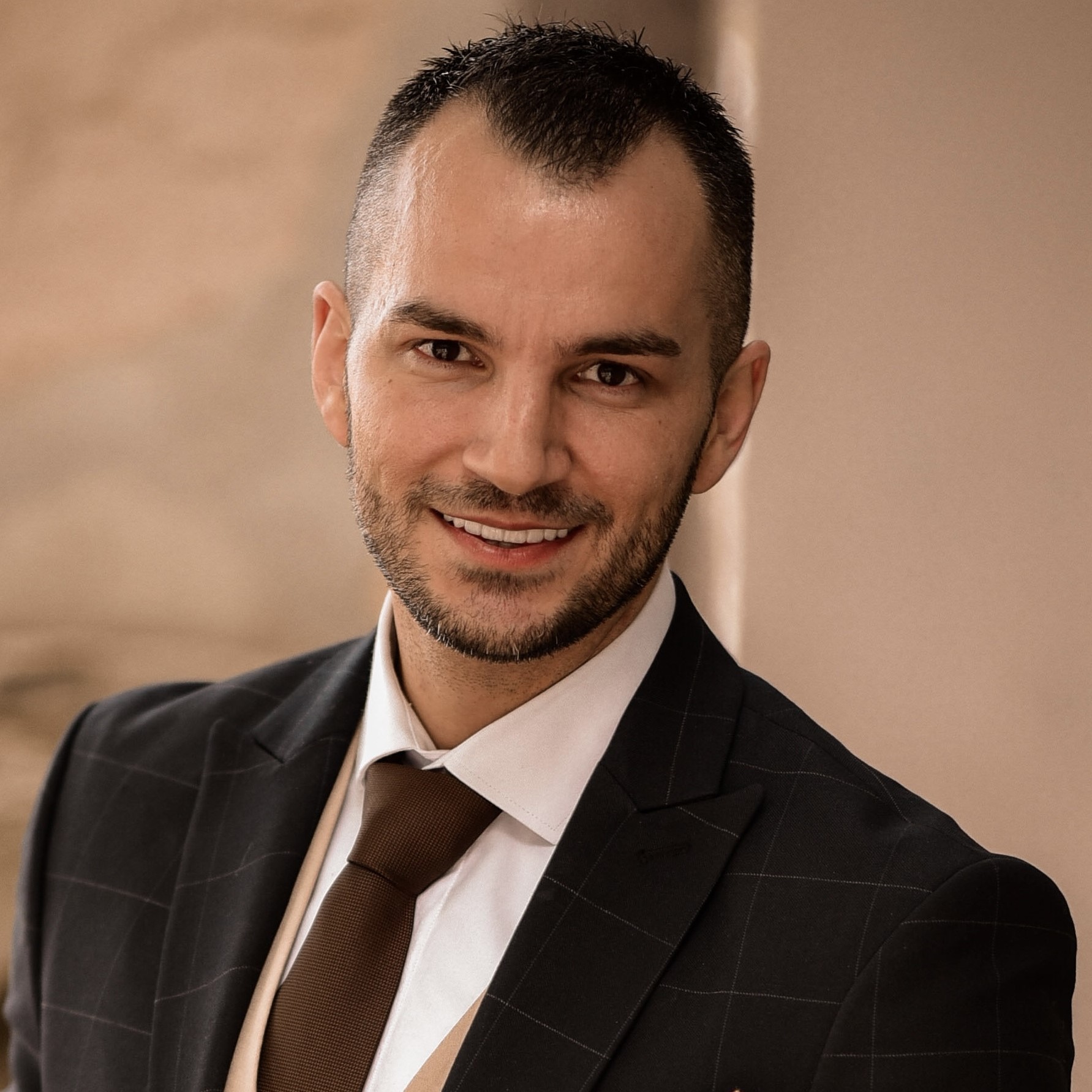
Milos Grujic
University Clinical Center Kragujevac, Radiation Oncology Dept., Kragujevac, RS

Miroslav Samarzija
Clinical Hospital Center Zagreb, Department of Pulmonary Diseases, Zagreb, HR

Nensi Lalic
Institute for Pulmonary Diseases of Vojvodna, Dept. of Pulmonary Oncology, Sremska Ramenica, RS
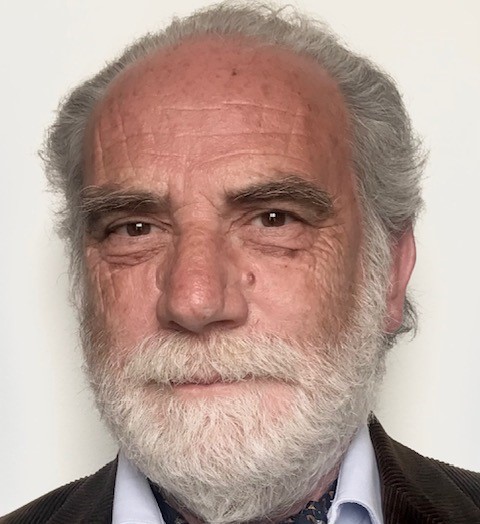
Riccardo A. Audisio
Institute of Clinical Sciences - Sahlgrenska University Hospital, Dept. of Surgery, Göteborg, SE

Sara Ramella
University Campus Bio-Medico, Radiotherapy Dpt., Roma, IT

Stefano Cafarotti
EOC - Ospedale Regionale Bellinzona e Valli, Thoracic Surgery Dpt., Bellinzona, CH

Tanja Cufer
University of Ljubljana, Medical Faculty, Ljubljana, SI
Thi Dan Linh Nguyen-Kim
University Hospital Zurich, Institute of Diagnostic and Interventional Radiology, Zurich, CH

Umberto Malapelle
University of Naples Federico II, Dpt. of Public Health, Naples, IT
Participation
The course is limited to 30 participants, selected through a competitive application.Priority is given to:
- Candidates aged 30–45 years
- With 2–3 years of oncology experience
- Who have previously attended an ESO Masterclass
- Who are fluent in English
How to Apply
Interested candidates must apply online and submit the following in PDF format:- Recommendation letter
- Short CV with publication list
- Abstract describing a clinical case
SELECTION PROCESS
Applications are evaluated through a two-step process:
- Automated Scoring: Some responses are assessed using a predefined scoring system to ensure fairness and consistency. Points are assigned based on your answers.
- Committee Evaluation: Other sections, including your qualitative responses, are reviewed and scored by our selection committee.
This type of evaluation ensures a transparent and unbiased selection of top candidates for participation in this activity.
Before you start completing the online application form, please be sure you have all the requested files (CV, Recommendation letter, and Clinical Case template) ready to be uploaded to the system. Online applications will not be considered unless all the files are uploaded.
You will be asked to accept ESO’s Data Protection Statement during the application process.
