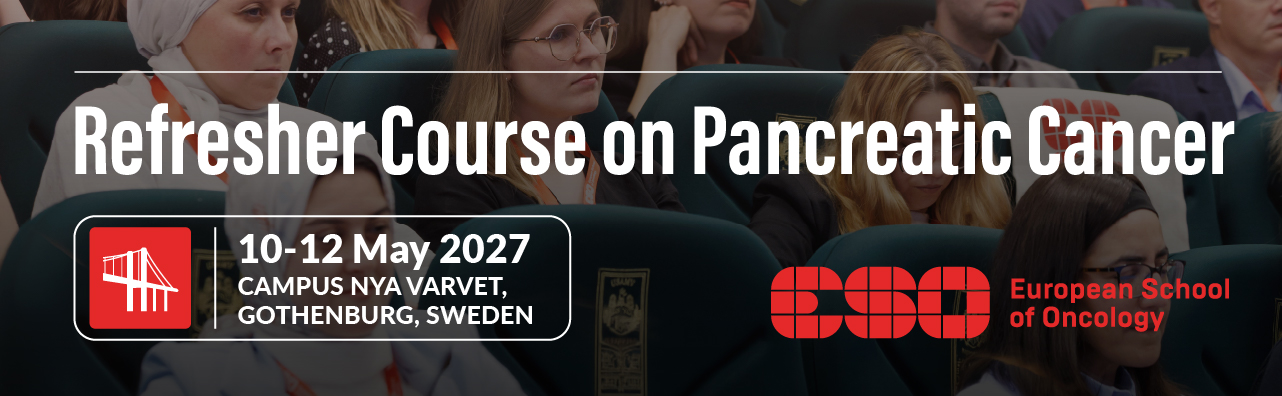
Refresher Course on Pancreatic Cancer
Refresher Course on Pancreatic Cancer
COURSE LEADERSHIP
Chairs - Riccardo Audisio, SE/IT, Carlos Carvalho, PT
Host Chair - Elena Rangelova, SE
COURSE OVERVIEW
Pancreatic cancer remains one of the most challenging malignancies, requiring close integration of diagnostic, surgical, pathological and oncological expertise, in close collaboration with research. This Refresher Course provides a focused update on the multidisciplinary management of pancreatic cancer, from initial diagnosis and staging to surgery, systemic treatment, recurrence and palliative care.
Through case-based presentations and interactive multidisciplinary discussions, participants will explore current approaches to imaging, pathology and tissue diagnosis, biomarkers, as well as the comprehensive management of localized, borderline resectable, locally advanced and metastatic disease in cross-talk with how to make valuable research.
The programme will address standard and advanced pancreatic surgery, including vascular resection and the management of surgical complications, alongside current systemic therapies, immunotherapy and clinical guidelines. Particular emphasis will be placed on challenging real-world scenarios and on translating clinical and translational research into practice.
The course will also address communication, teamwork and leadership, supporting a patient-centred and collaborative approach to complex pancreatic cancer care.
LEARNING OBJECTIVES
After completing this course, participants will be able to:
• Recognise the clinical presentation of pancreatic cancer and apply an appropriate diagnostic and staging approach.
• Integrate imaging, pathology, biopsy and biomarkers into multidisciplinary treatment planning.
• Understand current treatment strategies for localized, borderline resectable, locally advanced and metastatic pancreatic cancer.
• Apply contemporary principles of pancreatic surgery, including standard and vascular resections and the management of complications.
• Discuss current and emerging systemic treatments, including the role and limitations of immunotherapy.
• Evaluate challenging clinical scenarios involving recurrence, resection margins and treatment failure.
• Interpret current guidelines and understand how clinical and translational research informs practice.
• Strengthen multidisciplinary decision-making through interactive, case-based discussions.
• Develop effective approaches to difficult conversations, teamwork and leadership in pancreatic cancer care.
COURSE LANGUAGE and SCHEDULE
The course will be held in English. No translation will be provided.
10th May 2027: Arrival day
11th May 2027: Full-day course
12th May 2027: Half-day course
REGISTRATION FEE
The top 30 applicants will receive a place with accommodation with a reservation fee of EUR 160.
A further 30 applicants will be selected if eligible with a reservation fee of EUR 80 without accommodation.
The fee includes:
- Access to the full course and its educational resources
- Two nights’ accommodation (arrival: Monday 10th May– departure: Wednesday 12th May 2027)
- Meals as outlined in the programme
Travel costs are not covered and must be arranged independently.
ESO College members at the time of application receive a 50% discount on the registration fee.
The fee is a non-refundable contribution towards organisational costs and will not be reimbursed in the case of withdrawal or non-attendance, regardless of the reason.
ACCREDITATION
A certificate of attendance will be issued upon completion of:
• 100% attendance at the in-person course
• Completion of the evaluation questionnaire
• Application for CME recognition will be submitted to the European Accreditation Council for Continuing Medical Education (EACCME).
ESO COLLEGE MEMBERSHIP
Participation in this course grants eligibility to join the ESO College and allows existing members to earn 18 ESO College credits toward their progression.
Visit ESO College dedicated section for more information on membership and benefits.
INSURANCE
Participants are advised to take out personal and travel insurance. ESO is not responsible for incidents during the event.
CONTACTS
Elena Fiore – efiore@eso.net
Dolores Knupfer – dknupfer@eso.net
10/05/2027 18:00
Registration for Refresher participants at the hotel
10/05/2027 19:00
End of the registration
11/05/2027 08:30
Welcome
11/05/2027 08:45
Session 1: Clinical approach to a patient with pancreatic disease
08:45
Case 1: Round table discussion
09:30
Signs and symptoms of disease: case-presentation
09:50
Biopsy and stenting (case-based presentation)
11/05/2027 10:10
Coffee break
11/05/2027 10:30
Session 2: Back-to-back imaging (radiology and pathology)
10:30
Pathology in PC (case-based presentation)
11:00
Radiology in PC (case-based presentation)
11/05/2027 11:30
Session 3: Medical oncology in localized PC
11:30
Biomarkers for PC (opening case)
11:50
Medical oncology in localized PC (Case-presentation: Set-up scenarios)
11/05/2027 12:40
Lunch
11/05/2027 13:40
Session 4: Standard PC surgery
13:40
Patient assessment and prehabilitation (case-based presentation)
13:55
Standard pancreatic resections
14:10
Pancreatic surgery complications: early detection and treatment (case-based presentation)
11/05/2027 14:30
Session 5: Clinical and translational research:
14:30
Translational PC research (what a clinician should think about)
14:50
Clinical research in PC
11/05/2027 15:10
Session 6: Medical oncology in metastatic PC:
15:10
Oncologic therapy in the palliative setting
15:50
Coffee break
16:20
Why doesn’t immunotherapy work in PC?
16:35
The difficult conversation
16:50
PC Guidelines – which one to follow?
11/05/2027 17:10
End of the first day and free night
12/05/2027 08:30
Session 7: Surgical treatment of BR/LAPC
08:30
Surgery for BR/LAPC (case-based)
09:00
Technique for (vascular) resection – which are the limits
09:30
Consequences of advanced PC surgery
12/05/2027 10:00
Coffee break
12/05/2027 10:20
Round-table case-based discussions
10:20
Case 1: What to do if the plan fails (R at resection margin or negative frozen section turned positive: re-resection or chemo first)
10:20
Case 2: Unclear if Recurrence – start with chemo or wait to be sure?
10:20
Case 3: Recurrence or metachronous tumor: how to treat?
12/05/2027 12:00
Before you go: team-work, leadership, and preventing burn-out
12/05/2027 12:30
Closing remarks
12/05/2027 12:45
End of the course
Applications deadline: 1st February 2027
IDEAL CANDIDATE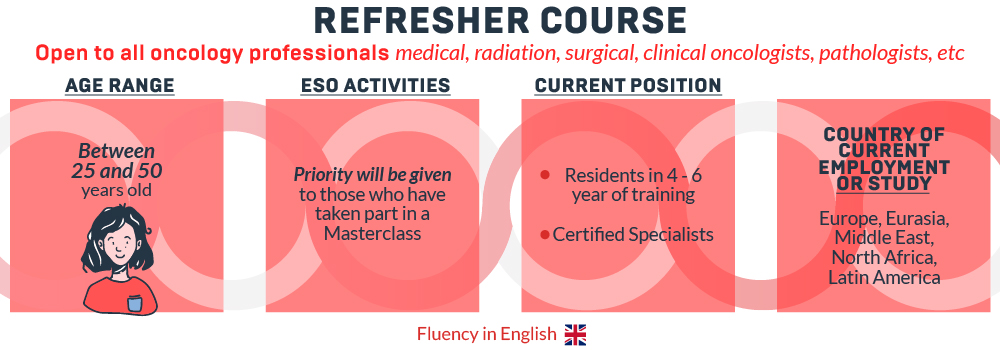
How to Apply
If interested please apply online.
The application process involves completing an online questionnaire, where you will provide details about
- Your work experience and training
- Your research experience and publications
- Your motivation and personal commitment to participating in this activity
During the application, you will also need to upload the following documents in PDF format:
- Recommendation letter: A letter from your head of department or mentor, written on official hospital letterhead and signed.
- Curriculum Vitae (CV)
- Clinical case: Please use the Clinical Case Template (download it HERE).
Applications without the required documents will not be considered. Please ensure all files are ready before starting the application form.
Abstract guidelines
Your abstract should present a challenging clinical case encountered in your daily practice that illustrates a relevant diagnostic or therapeutic dilemma.
A selected number of participants will be invited to present their case during an interactive multidisciplinary tumour board discussion with the faculty.
The abstract should include:
• Patient presentation and diagnostic work-up
• Treatment strategy and clinical outcome (where available)
• The rationale behind key management decisions
• A major clinical controversy or unanswered question illustrated by the case
• At least three discussion questions for the faculty and audience
• Three key learning points
Selection Process
Applications are evaluated through a two-step process:
Automated Scoring: Some responses are assessed using a predefined scoring system to ensure fairness and consistency. Points are assigned based on your answers.
Committee Evaluation: Other sections, including your qualitative responses, are reviewed and scored by our selection committee.
This type of evaluation ensures a transparent and unbiased selection of top candidates for participation in this activity.
Selected participants will be notified in February 2027.
Please ensure all documents are ready before starting the online application. Incomplete submissions will not be considered.
You will be asked to accept ESO’s Data Protection Statement during the application process.
