Basic principles in oncology course
HYBRID EVENT
Basic principles in oncology course
HYBRID EVENT
COURSE SCIENTIFIC LEADERSHIP:
Chairs – A. Constantinidou, CY - I. Tannock, CAESO College Rep/ESO Ambassadors – O. Mohamed, EG - R. Canario, PT
Course Overview
ESO offers a comprehensive introductory course for oncology trainees, designed to bridge the gap between undergraduate education and ESO’s renowned Masterclasses. The course provides orientation to the core principles of multidisciplinary cancer care and offers insight into the professional life of the modern oncologist.
While some foundational principles of oncology align with general medical training, increasing sub-specialisation has limited early exposure to oncological practice. As a result, new trainees often face unique challenges — from navigating a vast and complex curriculum, to adapting to a fast-evolving clinical environment, all while managing career planning, academic development, and work-life balance.
The programme is built around learning outcomes derived from internationally published curricula across all oncology specialties. Each session aligns with globally recognised educational frameworks to ensure relevance and consistency for oncology professionals worldwide. Emphasis is placed on clinical decision-making in real-world scenarios, optimal sequencing of therapies, and collaboration within multidisciplinary teams. The course also addresses current controversies, emerging evidence, and future directions.
Learning Objectives
Participants will receive structured updates and introductions on the following topics:• Fundamentals of etiology and epidemiology
• Basics of cancer genetics, staging, and imaging
• Essentials of surgical oncology and pathology
• Principles of radiotherapy and chemotherapy
• Introduction to paediatric oncology
• Overview of tumour boards and key patient-centred issues: communication, supportive and palliative care
• Introduction to clinical trials and critical appraisal of scientific literature
Venue
The course will be held at Instituto Português de Oncologia (IPOP), Porto
Course Format
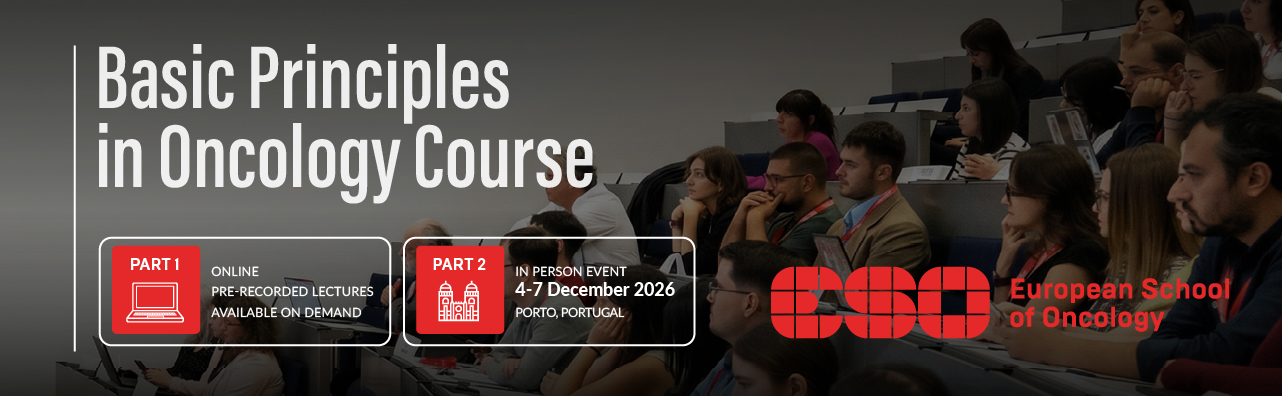
The course is divided into two parts:• Part 1 – Online Learning
Participants will complete a series of pre-recorded lectures made available online.
These must be completed prior to the in-person event.
• Part 2 – In-Person Event
Location: Porto, Portugal
Dates: 5 – 7 December, 2026
Duration: 2.5 days
Language
The course will be held in English. No translation services will be provided.
Registration Fee
Selected participants will be asked to confirm their attendance by paying a registration fee of EUR 150,00 which includes:- Access to the full course and its educational materials
- 3 nights’ accommodation (4 - 7 December 2026)
- Meals as outlined in the programme
Travel costs are not covered and must be arranged independently.
ESO College members at the time of application and local participants who don’t require accommodation receive a 50% discount on the registration fee.
The fee is a non-refundable contribution towards organisational costs and will not be reimbursed in the case of withdrawal or non-attendance, regardless of the reason.
Accreditation
Participants must attend at least 75% of the course to receive a certificate of attendance.
To obtain the certificate, participants must also complete an online evaluation questionnaire and a learning assessment test. Certificates will be sent via email.
Application for CME recognition will be submitted to the Accreditation Council of Oncology in Europe (ACOE).
ESO College Membership
Participation in this course grants eligibility to join the ESO College and allows existing members to earn 18 ESO College credits toward their progression.
Visit ESO College dedicated section for more information on membership and benefits.
Insurance
ESO cannot be held responsible for any personal or travel-related incidents.Participants are strongly advised to arrange their own personal and travel insurance coverage.
Contacts – Organising Secretariat
Corinne HallEuropean School of Oncology
+39 331 6125784
chall@eso.net
Dolores Knupfer
European School of Oncology
+41 91 820 09 50
dknupfer@eso.net
Part 1 - Basic Priniciples in Oncology
Part 2 - Basic Priniciples in Oncology
Participation
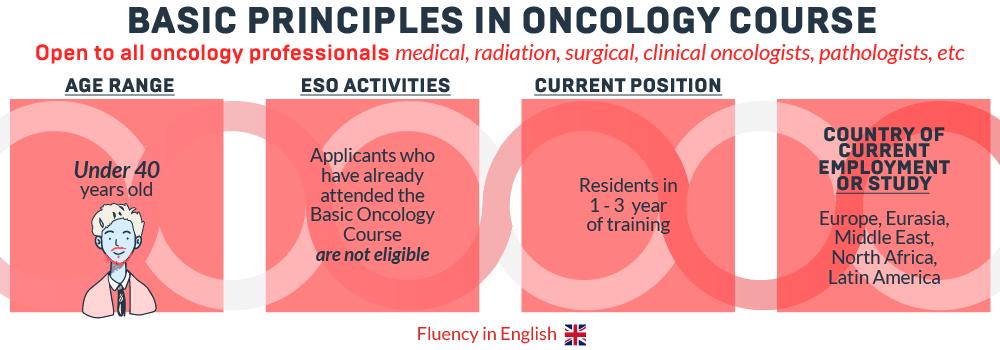
The course is open to 60 participants, selected through a competitive application process.Priority will be given to applicants who have previously attended ESO–ESSO–ESTRO-ESP course for medical students.
Ideal Candidate

How to Apply
Applications must be submitted online You will be asked to complete a questionnaire detailing:
- Your professional and training background
- Your research experience and publication
- Your motivation and personal commitment
Required documents (in PDF format):
- Recommendation letter: Signed and on official hospital letterhead, from your head of department or mentor
- Curriculum Vitae (CV)
Please ensure all documents are ready before starting the online application. Incomplete submissions will not be considered.
You will be asked to accept ESO’s Data Protection Statement during the application process.
Selection Process
Applications are evaluated through a two-step process:1. Automated Scoring
Certain sections of the application are assessed using a predefined points-based system to ensure fairness and consistency.
2. Committee Review
Qualitative sections, including motivation and personal statements, are reviewed and scored by ESO’s selection committee.
This dual approach ensures a transparent, balanced and merit-based selection of the most suitable candidates.
